
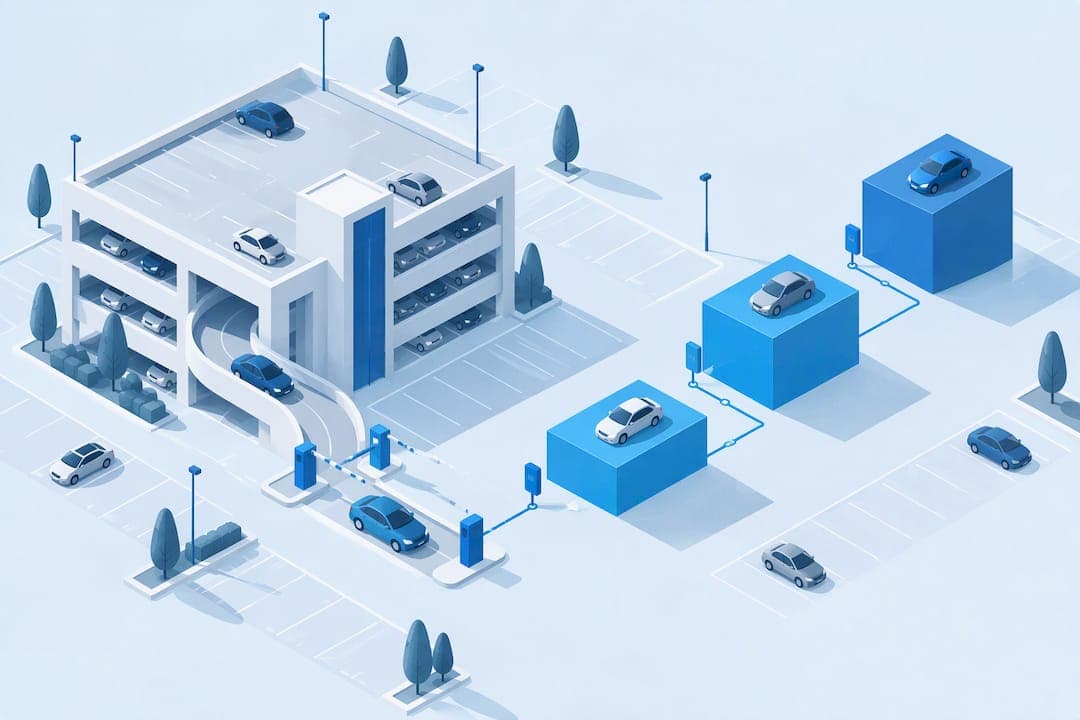
Treat shopping mall parking as a revenue-generating asset by combining real-time occupancy data with layered pricing and reservation or validation tools. This approach reduces circling, supports better tenant experience, and increases revenue per space. Operator-focused platforms like PinPark make this practical without requiring a lot of reconfiguration or a long installation process.
TL;DR:
- Dynamic, demand-responsive pricing and layered strategies can significantly increase revenue by maintaining optimal occupancy levels of 60-80 percent.
- Overhead camera systems with ANPR provide comprehensive occupancy and enforcement data at a lower installation cost than per-space sensors.
- Implementing reservation and validation options linked to retail purchases simplifies parking management and reduces disputes at exit points.
- A 90-day pilot involving baseline measurement, phased installation, and layered pricing testing can demonstrate revenue uplift and optimal occupancy targets.
- Continuous communication with tenants and operators, along with gradual system rollout, prevents disputes and maximizes revenue benefits.
Table of Contents
- Why mall parking deserves treatment as a performance asset
- Core tech and data stack for shopping center parking
- Pricing strategies that work for malls: a layered approach
- Reservations, validation, and peak-event handling
- Operational changes: enforcement, staffing, and quick installs
- Estimating ROI and a 90-day pilot plan
- What operators get wrong about mall parking
- How PinPark helps shopping center operators
- Sources
- FAQ
Why mall parking deserves treatment as a performance asset
Parking has traditionally been viewed as a cost center at shopping centers, a line item to maintain rather than a revenue source to manage. That view is changing. Industry analysis shows that parking optimization can materially change underwriting and NOI, with dynamic pricing and data-enabled operations increasing revenue per space in a way that shows up directly on a pro forma. Retail property owners who once ignored parking are now underwriting it as a stand-alone contributor to cash flow.

The evidence from public pilot programs backs this up. The FHWA compendium of active parking management pilots documents that SFpark achieved its target occupancy 30% more often after introducing demand-responsive pricing, while search time for parking dropped by 43% and double parking fell by 22%.
Two levers drive parking revenue, and operators need to manage both:
- Transaction count, meaning how many vehicles use the facility over a given period.
- Revenue per transaction, meaning how much each parker pays, which pricing and validation policies directly control.
SFpark's demand-responsive pricing pilot cut parking search time by 43% and reduced double parking by 22%, showing that pricing and real-time information together change driver behavior at scale.
Core tech and data stack for shopping center parking
Shopping centers present a specific challenge: multiple entrances, high vehicle turnover during peak hours, and tenants who expect predictable, low-friction access. Choosing the right monitoring approach matters as much as the pricing strategy layered on top of it.
Overhead camera systems with automatic number plate recognition (ANPR) cover wide areas from a small number of installation points, which suits mall lots with several entry and exit lanes. Per-space sensors give more granular data on individual stalls but require far more hardware across a large surface lot, driving up installation cost and maintenance overhead for a property with hundreds or thousands of spaces.
LPR and ANPR technology supports several operational functions beyond basic occupancy counting:
- Tenant plate recognition for reserved employee or delivery parking.
- Point-of-sale validation, linking a shopper's purchase directly to free or discounted parking.
- Loyalty program integration, rewarding frequent shoppers with parking perks tied to their account.
Industry coverage of retail parking upgrades notes that operators replacing legacy gate and kiosk systems with camera and LPR platforms reduce friction at entry points while gaining the data needed for enforcement and pricing decisions in one system.
Pro Tip: Start with camera-based ANPR at entrances and exits before considering per-space sensors. It gives you occupancy and enforcement data across the whole lot with far less hardware to install and maintain.
Pricing strategies that work for malls: a layered approach
A single flat rate leaves revenue on the table and does nothing to manage congestion during peak shopping periods. A layered pricing structure performs better because it matches price to actual demand instead of guessing at it.
- Test a base rate first. Set an annual or seasonal baseline price and observe how occupancy responds before adding complexity.
- Add static surge pricing for known peaks. Holiday weekends, back-to-school periods, and major sales events get a predictable higher rate set in advance.
- Layer in demand-responsive pricing. Prices adjust in near real time based on current occupancy, similar to the model FHWA documented in SFpark and similar pilots.
- Set an occupancy target, not a full-lot target. Aim for 60 to 80% occupancy rather than 100%, since a full lot means shoppers circling for a spot and abandoning visits.
- Run pilot windows before rolling out changes lot-wide. Test one pricing tier for two to four weeks, measure occupancy and revenue-per-space, then adjust.
The FHWA active parking management pilots show that facilities held their 60-80% occupancy target 30% more often once demand-responsive pricing was introduced, confirming that equilibrium, not maximum fill, produces the best outcome for both revenue and shopper experience.
Reservations, validation, and peak-event handling
A reservation and validation system gives shoppers certainty and gives operators a direct line between parking policy and tenant sales. The two goals are not in tension when the policy is designed correctly.
A workable reservation and validation framework includes the following elements:
- Free parking for the first two hours, with paid reservations available for guaranteed spots beyond that window.
- Rolling booking options that let shoppers reserve a spot ahead of a planned visit, particularly useful during known peak periods.
- POS validation flows that link a retail purchase to free or discounted parking, reducing disputes at the exit gate because the system, not a staff member, confirms eligibility.
- Overflow routing to secondary lots or structures when primary capacity nears its occupancy target, communicated through digital signage.
- Temporary staffing increases for major events and holiday weekends, focused on wayfinding rather than manual gate operation.
This structure keeps the parking experience predictable for shoppers while giving tenants a system that supports their sales rather than complicating them.
Operational changes: enforcement, staffing, and quick installs
Adopting a data-driven parking system changes daily operations more than it changes the physical lot. Installation itself can be minimally disruptive when it relies on overhead cameras and a cloud-based platform rather than a full lot reconfiguration.
Expect these operational shifts once the system is running:
- Enforcement moves from manual patrols to automated compliance checks using LPR, with clear posted policy for tenants and shoppers.
- Staffing schedules adjust based on occupancy analytics instead of fixed shifts, putting people on-site when demand data shows they are needed.
- Tenant reporting becomes a routine output of the system, giving property management concrete occupancy and revenue data to share at lease renewal conversations.
- Phased rollouts let operators start with one entrance or one lot section before expanding, limiting disruption during the transition.
Pro Tip: Roll out enforcement changes gradually and communicate the new policy to tenants before it goes live. A predictable, automated system reduces disputes far more than a sudden change in gate behavior.
Estimating ROI and a 90-day pilot plan

A simple ROI model starts with current transaction volume and average revenue per transaction, then applies a conservative uplift estimate from layered pricing and reduced circling. Industry reporting on premium parking services and reservation-based dynamic pricing pilots shows commercial parking facilities have achieved measurable revenue gains once validation and demand-based pricing replace flat-rate systems.
A 90-day pilot follows a straightforward sequence:
- Weeks 1 to 2: Establish a baseline of current occupancy, transaction count, and revenue per space.
- Weeks 3 to 4: Install camera-based monitoring at key entrances with minimal lot disruption.
- Weeks 5 to 8: Run layered pricing tests across defined windows, comparing results against baseline.
- Weeks 9 to 12: Measure outcomes and decide whether to scale the system lot-wide.
| Metric | Baseline period | Pilot target |
|---|---|---|
| Occupancy rate | Below target | 60-80% occupancy |
| Revenue per space | Current average | Measured uplift versus baseline |
| Search time for parking | Current average | Reduced versus baseline |
What operators get wrong about mall parking
Most operators treat parking pricing as a set-and-forget decision, reviewed once a year if at all. That cadence misses every seasonal swing in demand a shopping center actually experiences. The bigger mistake is running pricing changes without looping in tenants first, since a sudden validation policy shift or a new paid tier can generate complaints that have nothing to do with the pricing logic itself and everything to do with poor communication.
Coordination with tenants and consistent pricing review cycles matter more than any single technology choice. Operator-focused platforms such as PinPark give facility managers a direct path to implementing these changes without building the analytics from scratch.
— Noman
How PinPark helps shopping center operators
PinPark gives parking lot owners and facility managers the tools this article describes in one platform, without requiring a lot reconfiguration to get started.

PinPark's operator-facing platform includes:
- Real-time occupancy monitoring using AI-powered overhead cameras.
- Dynamic pricing tools built on demand analytics.
- Reservation and validation management for tenant and shopper use.
- Minimal-disruption installation designed for active retail properties.
Facility managers can request a revenue-per-space estimate and review pricing details on the PinPark for operators page.
Sources
For further reading on the evidence behind this playbook, see the FHWA active parking management pilots, the ICSC coverage of parking and net operating income, and the CREDA analysis of parking asset performance.
- Strengthening Linkages between Transportation Demand Management and Traffic Management - FHWA
FAQ
What is the best occupancy target for shopping mall parking?
The FHWA pilot data shows this range balances shopper convenience with revenue, since a fully occupied lot means circling and lost visits.
How does dynamic pricing work for shopping center parking?
Dynamic pricing adjusts rates based on real-time occupancy data, raising prices as a lot approaches its occupancy target and lowering them when demand is low. Programs like SFpark used this model to hold target occupancy 30% more often than static pricing allowed.
What does PinPark cost for parking operators?
PinPark's operator subscription is priced at $10 per month per managed space. The platform covers real-time occupancy monitoring, dynamic pricing, and reservation management within that subscription.
How disruptive is installing a smart parking system at a mall?
Camera-based systems with overhead ANPR require minimal changes to the physical lot, since cameras mount at existing entrances and exits rather than requiring sensors in every space. Phased rollouts, starting with one entrance or lot section, further limit disruption during installation.
Can parking validation reduce disputes at mall exits?
Yes, POS validation flows that link a retail purchase directly to free or discounted parking remove the need for manual confirmation at the gate. This reduces disputes because the system, not a staff member, verifies eligibility automatically.