
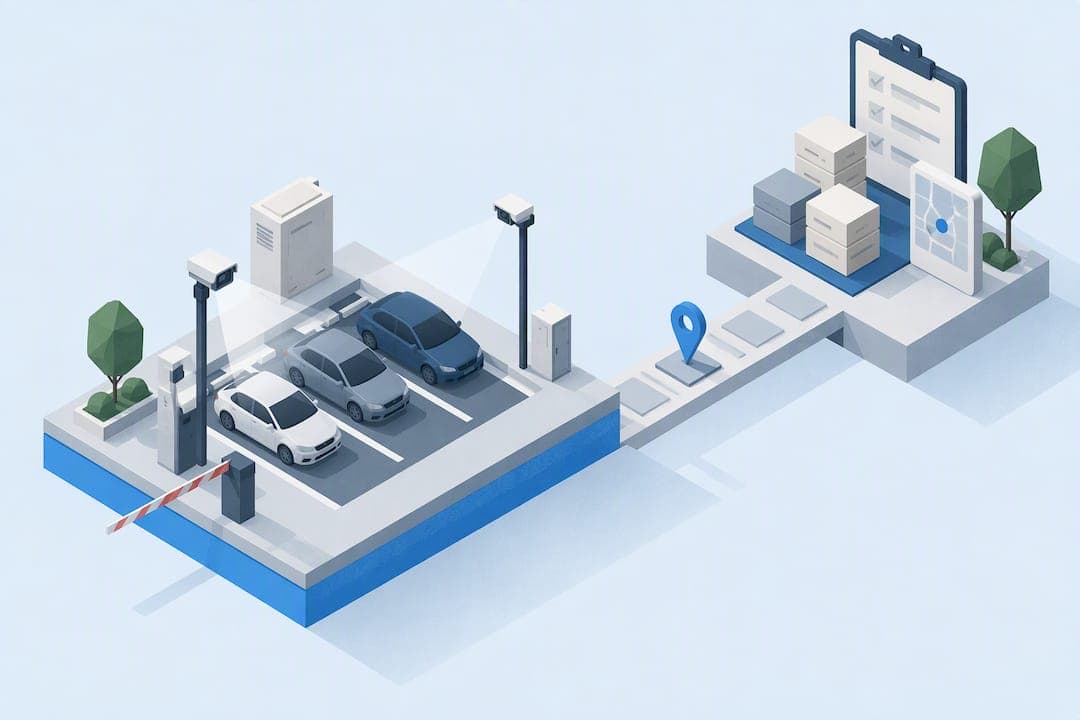
LPR parking enforcement automates license-plate reads to validate permits and payments in real time, letting one officer or vehicle cover ground that used to take an entire shift. It multiplies coverage without multiplying headcount, and it produces a timestamped, photographed record that holds up in appeals. For most mid-size to large lots and municipal zones, piloting LPR is worth the investment. For small single-lot operations, the math may not close yet.
TL;DR:
- LPR systems can read license plates at speeds that support real-time enforcement, capturing successful reads in about 50 milliseconds per vehicle.
- Combining fixed, mobile, and handheld camera deployment models maximizes coverage and addresses specific operational needs, though it increases upfront costs.
- Costs for retrofitting a single enforcement vehicle with mobile LPR equipment range from $50,000 to $65,000, with fleet-wide projects reaching hundreds of thousands of dollars.
- Effective LPR use depends on real-time permit and payment database integration, occupancy data, and carefully managed privacy and retention policies.
- Environmental factors like weather, lighting, and plate conditions, as well as regional plate formats, significantly impact accuracy and require strategic camera placement and maintenance.
Table of Contents
- How LPR Parking Enforcement Actually Works
- Fixed, Mobile, and Handheld: Choosing a Deployment Model
- What LPR Costs and How to Estimate Real ROI
- Privacy, Retention, and Policy: What Compliance Actually Requires
- Connecting LPR Reads to Permits, Payments, and Citations
- Keeping Read Accuracy High in the Field
- Rolling Out LPR: A Practical Checklist and Timeline
- Where an Occupancy Platform Fits Alongside LPR
- Where LPR Falls Short and How to Work Around It
- How LPR Providers and Systems Actually Differ
- How Drivers Experience LPR Enforcement
- What's Next for LPR in Parking Enforcement
- The Real Gap in LPR Adoption Isn't the Camera
- See What Real-Time Occupancy Data Adds to Your Enforcement Stack
- Sources
- FAQ
How LPR Parking Enforcement Actually Works
License plate recognition parking systems follow a fixed pipeline: a camera captures an image, software localizes the plate within the frame, optical character recognition (OCR) converts the characters into a text string, and that string gets checked against a permit, payment, or watchlist database. The entire sequence sounds slow when you describe it. It isn't.
Under controlled conditions, plate-character processing can happen in roughly 50 milliseconds, according to the technical overview on automatic number-plate recognition. That speed is what makes "real time" a meaningful operational claim rather than marketing language: a vehicle rolling past at 10 to 15 mph can still generate a usable, matched read before it clears the frame.
When you evaluate vendors, ask for numbers, not adjectives. Request:
- Read rate (percentage of plates successfully captured and decoded per pass)
- Confidence score thresholds (what triggers automatic acceptance versus manual review)
- Average read-to-match time under your specific lighting and traffic conditions
Pro Tip: Ask vendors to demo their system on your actual plates, in your actual lot lighting, not a showroom sample set. Regional plate formats and glare patterns vary enough that a 98% read rate somewhere else can slip in your conditions.
Fixed, Mobile, and Handheld: Choosing a Deployment Model
The three core deployment types solve different problems, and most mature operations end up running more than one.
- Fixed cameras mount at gates, entries, or exits and excel at high-traffic chokepoints like garages and gated lots, where every vehicle passes a known point.
- Vehicle-mounted (mobile) systems patrol curb zones, campus perimeters, and sprawling surface lots where a moving platform covers far more linear footage than a stationary camera ever could.
- Handheld units fill the gaps: tight alleys, temporary event zones, or spot checks where installing hardware doesn't make sense.
A university with a walled perimeter and defined entry points leans toward fixed cameras. A municipality enforcing curb time limits across many blocks needs mobile units. A private garage operator with two entrances might run fixed cameras at the gates and skip mobile altogether. Combining methods costs more upfront, but it closes coverage gaps that a single deployment type leaves exposed.
What LPR Costs and How to Estimate Real ROI
Budget realistically before you pitch a pilot to finance. Retrofitting a single existing enforcement vehicle with a mobile LPR system typically runs $50,000 to $65,000, covering rooftop and wheel-imaging cameras, the trunk processing unit, and in-vehicle computing hardware. That figure covers one vehicle. Fleet-wide rollouts scale up fast, and agencies converting entire fleets often report initial costs reaching well into the high hundreds of thousands once hardware, integration, and backend systems are all accounted for.
Ongoing costs don't stop at hardware. Budget for software licensing, data storage and retention infrastructure, routine maintenance, and staff training on both the software interface and appeals procedures.
The ROI case usually rests on three levers: more citations issued per labor hour, faster patrol cycles, and improved compliance rates as drivers learn the lot is actively monitored. Independent case-study research on fixed-camera deployments found substantially higher net income compared to manual enforcement in a university parking setting, driven mainly by consistency (cameras don't skip rounds) rather than by issuing more tickets per violation, according to a cost-benefit analysis of fixed-camera versus manual enforcement.
Privacy, Retention, and Policy: What Compliance Actually Requires
LPR technology for parking captures data on every vehicle it scans, not just violators, and that fact drives most of the regulatory scrutiny the technology attracts. Public adoption concerns center squarely on privacy, and many cities now require a surveillance impact report and a public-facing retention policy before an ALPR system goes live, per the same ANPR technical overview referenced above.
Municipal policies commonly separate "reads" from "hits." A published example from Green Bay's ALPR policy sets a 14-day retention window for non-hit reads, while records tied to actual enforcement actions are held longer under documented access controls.
Before deployment, draft:
- A stated purpose limitation (parking enforcement only, not general surveillance)
- A retention schedule that separates reads from enforcement hits
- Named roles with system access and an audit trail for queries
- A public notice explaining what's collected and for how long
Pro Tip: Write your retention policy into the procurement RFP itself, not as an afterthought once the vendor is selected. It's far easier to negotiate data-handling terms before signing than to renegotiate after the system is running.
Connecting LPR Reads to Permits, Payments, and Citations
A plate read only becomes useful once it's checked against live data. A read matched to a stale nightly database export is functionally useless if a driver bought a permit or paid for parking ten minutes earlier, an integration gap that undermines the entire case for automation, as noted in operational guidance on how LPR works in modern parking enforcement.
Core integrations to prioritize:
- Permit database, synced in real time or near real time
- Pay-by-phone and kiosk payment platforms
- Citation back-office software for issuing and tracking tickets
- Watchlists for scofflaws, stolen vehicles, or banned plates
Evidence capture matters just as much as the match itself. Every citation-worthy read should log a timestamped photo, GPS coordinates, and the confidence score at time of capture, forming a chain of custody that survives an appeal hearing. Build in manual override procedures for edge cases: a permit purchased minutes before the scan, a sync delay between systems, or a plate obscured by a bike rack. Without those overrides, sync delays alone will generate a steady stream of disputable citations.
Keeping Read Accuracy High in the Field
Field performance depends on variables no spec sheet fully captures: capture angle, ambient lighting, plate condition, and how well the system's OCR model covers your region's plate formats. A dirty, bent, or glare-hit plate can drop read confidence even on a well-tuned system, which is why mature platforms flag low-confidence reads for manual review instead of auto-accepting them, according to the OPSCOM operational guide.
Build these into daily operations:
- Set a confidence threshold below which a read routes to a human for verification before any citation issues
- Run a daily QA sample, spot-checking a percentage of automated reads against the actual photo
- Track read rate, hit-to-violation conversion, and false positive rate as your three core operational metrics
Pro Tip: Resist judging pilot success purely on the vendor's stated top-line accuracy number. A practical evaluation weighs read rate, violations issued per hour, and false positive rate together, since a system can post a high read rate while still generating a disqualifying number of disputed citations.
Rolling Out LPR: A Practical Checklist and Timeline
Treat your pilot as a data-collection exercise first and an enforcement upgrade second.
Procurement checklist:
- Confirm hardware specs: camera resolution, mounting hardware, in-vehicle or gate-side processing units
- Define software requirements: OCR engine, confidence thresholds, database integration APIs
- Line up integration partners for permit, payment, and citation back-office systems
Pilot and rollout steps:
- Define success metrics before day one (read rate, false positive rate, citations per hour)
- Run the pilot across a defined sample period, typically four to eight weeks, in your toughest lighting and traffic conditions
- Train staff on manual override and appeals procedures before go-live
- Publish the public notice and finalize policy sign-off ahead of full deployment
- Expand in stages, lot by lot or zone by zone, rather than switching an entire operation overnight
Where an Occupancy Platform Fits Alongside LPR
LPR tells you which plates violated the rules. It doesn't tell you where your lot sits empty at 2 p.m. or which zones chronically overflow. Pairing plate reads with real-time occupancy data, the kind PinPark's operator platform provides through overhead cameras, lets managers direct enforcement patrols toward zones with actual demand pressure instead of patrolling uniformly. Installation requires minimal disruption to existing lot layouts, a detail worth weighing against LPR's own hardware retrofit costs.

Where LPR Falls Short and How to Work Around It
No LPR parking system reads every plate, every time, and pretending otherwise sets up your operation for disputes you'll lose. The most common limitation is environmental: heavy rain, direct glare, snow-covered plates, or poor nighttime lighting all suppress read rates below vendor-quoted benchmarks. The fix isn't better software alone. It's positioning cameras to minimize backlight, adding supplemental lighting at mobile-patrol chokepoints, and accepting that some percentage of passes will require a manual look.

A second limitation is plate-format coverage. Systems trained primarily on domestic plates can stumble on out-of-state or international formats, temporary paper plates, or older, faded issues. Regional coverage should be a specific line item in vendor evaluation, not an assumed capability.
Integration lag causes a disproportionate share of appeal disputes. A driver who paid via a mobile app 90 seconds before a patrol vehicle scans their plate shouldn't receive a citation, but if the payment platform and the LPR system sync on a delay, that's exactly what happens. Mitigate this by negotiating near-real-time sync requirements into vendor contracts and building a grace-period buffer into your citation logic.
Finally, public trust is a genuine constraint, not a soft one. Communities that feel surveilled without explanation push back through city councils and public comment periods, sometimes freezing programs mid-deployment. Transparent policy and a clear purpose limitation, covered in the privacy section above, function as much as a scheduling risk-mitigation tool as they do a compliance requirement.
How LPR Providers and Systems Actually Differ
Vendors in this space tend to differentiate along a few practical axes rather than one another's marketing copy: hardware form factor, OCR engine maturity, integration depth, and deployment support model.
Hardware form factor is the first fork. Some providers sell dedicated rooftop and wheel-imaging camera rigs built specifically for enforcement vehicles; others offer camera add-ons compatible with existing dash or body-worn systems already in an agency's fleet. The former tends to deliver higher read rates in motion; the latter tends to cost less to adopt if you already own compatible hardware.
OCR engine maturity shows up in edge-case handling, specifically how a system performs on damaged plates, unusual regional formats, and low-light captures, rather than in a headline accuracy percentage that rarely reflects your actual field conditions.
Integration depth separates providers more than any other factor. A system that reads plates accurately but bolts onto your permit database through a nightly batch export will generate more disputes than one built for live, bidirectional sync with payment and citation platforms.
Finally, weigh deployment support. Some providers hand you hardware and a manual; others run staged pilots, provide staff training, and stay involved through your first full enforcement cycle. For a technology this operationally dependent on correct configuration and staff procedure, that support model often matters more than any spec on a data sheet.
How Drivers Experience LPR Enforcement
Reaction to LPR parking enforcement splits along a predictable line: drivers who follow the rules barely notice it, while those who don't tend to perceive it as unfair, even when it's simply consistent.
That consistency is actually the source of most public friction. A human patrol officer might miss a slightly-expired permit on a busy day; a camera doesn't. Drivers accustomed to a little slack in manual enforcement sometimes read algorithmic consistency as harshness, even when the underlying rule never changed. Managers who roll out LPR without communicating this shift tend to see a spike in appeals and complaints in the first few weeks, not because the system is wrong more often, but because it's wrong less often in the driver's favor.
Signage and communication blunt this friction significantly. Lots that post clear notices explaining that plate recognition technology is in use, paired with a straightforward appeals process, report fewer confrontational disputes than lots that deploy the technology silently. Perception also improves when enforcement pairs with convenience: drivers who can pay by phone, extend a session remotely, or check real-time availability before they park tend to view camera-based enforcement as part of a modern, self-service system rather than a punitive one.
The appeals process itself shapes public trust more than the technology does. A citation backed by a timestamped photo, GPS location, and a clear confidence score is far easier for a driver to accept, right or wrong, than a citation with no supporting evidence. Transparency at the point of dispute does more for public perception than any messaging campaign before deployment.
What's Next for LPR in Parking Enforcement
The near-term trajectory for LPR parking systems points toward tighter integration rather than dramatically new capture technology. Plate-reading OCR is already fast and largely commoditized; the competitive edge is shifting toward what happens after the read, meaning live database matching, occupancy-aware enforcement routing, and dynamic policy application based on real-time demand.
Expect broader adoption of confidence-based automation, where systems handle high-confidence matches automatically and route only borderline reads to human reviewers, narrowing the manual workload without removing the human check entirely. That shift matters for staffing models: enforcement officers increasingly manage exceptions rather than routine reads.
Occupancy and demand data are converging with enforcement platforms, too. Rather than patrolling on a fixed schedule, managers are starting to route enforcement toward zones flagged as high-turnover or overstay-prone by real-time sensor and camera data, a pairing that makes each patrol more productive per mile driven.
Policy is evolving in parallel with the technology. As more municipalities publish ALPR-specific ordinances, similar in structure to policies from cities like Berkeley that limit use to specific stated purposes, expect procurement contracts to increasingly bake in purpose limitations and access controls as standard contract language rather than optional add-ons. Vendors who build compliant retention and access architecture into their base product, rather than treating it as a custom configuration, will have an edge as these requirements standardize across jurisdictions.
The Real Gap in LPR Adoption Isn't the Camera
Most of the conventional advice on LPR parking enforcement fixates on read rate percentages, as if a system quoting 97% accuracy automatically outperforms one quoting 94%. That number matters less than what happens to the 3 to 6% of reads that fail. Systems that route low-confidence reads to a human reviewer before a citation issues consistently outperform systems that auto-accept every match, regardless of which one posts the flashier spec sheet.
The bigger blind spot is treating LPR as a standalone purchase instead of one layer in an enforcement stack. A plate read means little without live permit and payment data behind it, and it means even less without occupancy context telling you where enforcement effort actually pays off. Managers who buy the camera hardware first and figure out integration later are the ones who end up with the appeal backlogs and public trust problems described above.
Prioritize integration architecture and retention policy before you shop cameras. Get those two right, and read rate becomes a tuning problem instead of an existential one.
— Noman
See What Real-Time Occupancy Data Adds to Your Enforcement Stack
Plate reads answer who violated the rules. They don't answer where your enforcement effort is wasted on zones that are already empty, or where it's needed most during a Saturday event surge. PinPark's AI-powered cameras give operators live occupancy data across every space, without reconfiguring the lot, so enforcement patrols and staffing decisions follow actual demand instead of a fixed patrol route.

The subscription runs $10 per month per space, covering the occupancy dashboard, dynamic pricing tools, and the driver-facing app that lets visitors reserve and pay without adding staff workload. Before a demo, gather your current lot layout, peak-hour occupancy estimates, and any existing permit or payment systems you'll need to integrate. Visit the PinPark for operators page to schedule a walkthrough and see how occupancy data lines up against your current enforcement patterns.
FAQ
What Does LPR Mean in Parking?
LPR stands for license plate recognition, the camera and OCR technology that reads plate characters and checks them against permit, payment, or violation databases. In parking enforcement, it automates the process of confirming whether a parked vehicle has paid or holds a valid permit.
How Can Drivers Avoid Automatic Number Plate Recognition Issues?
Drivers avoid disputes mainly by keeping plates clean, unobstructed, and properly mounted, since dirt, damage, or glare are the most common causes of failed or low-confidence reads. Paying or registering a permit promptly, and understanding the system's grace period for sync delays, also reduces the odds of a contested citation.
How Much Does an LPR System Cost?
A mobile LPR retrofit on a single existing enforcement vehicle typically runs $50,000 to $65,000, covering cameras, mounts, and processing hardware. Fleet-wide deployments scale well beyond that per-vehicle figure once integration and backend systems are included, while an occupancy-focused platform like PinPark runs $10 per month per managed space.
How Do I Report Illegal Parking?
Most municipalities and private lots provide a dedicated phone line, app, or web form for reporting illegal parking, often tied directly into the same citation system that processes LPR-generated violations. Check your local parking authority's website or the signage posted at the lot for the specific reporting channel that applies to that location.