
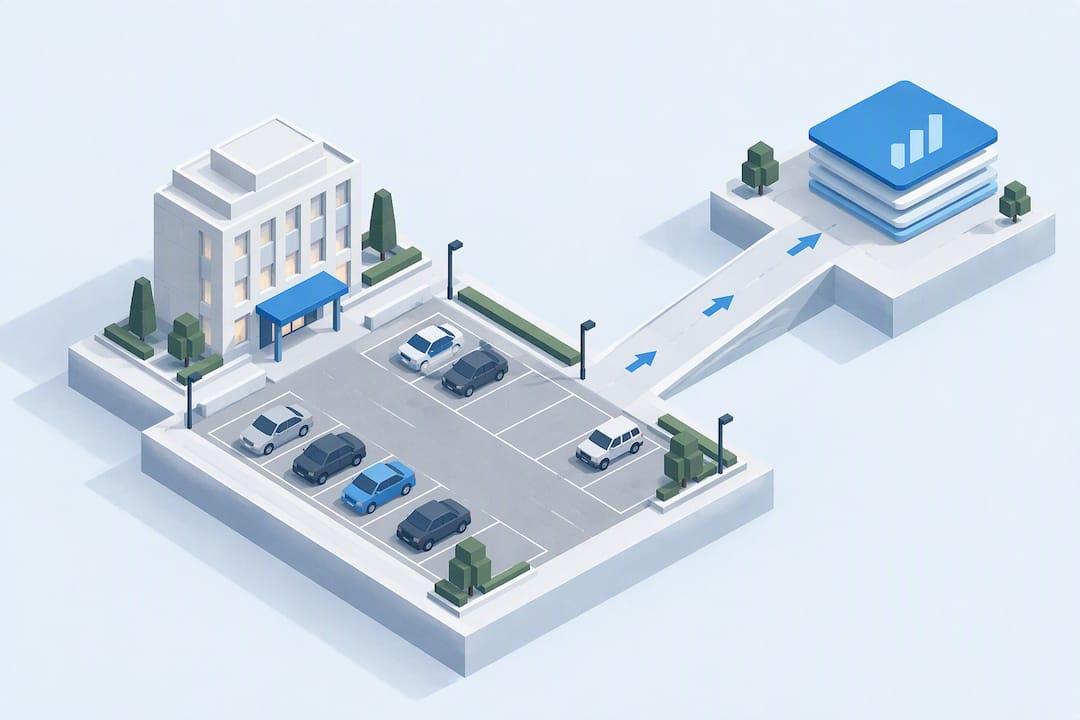
For most hotels without a dedicated parking department, the better path is a tech-enabled outsourced model. This approach keeps high-touch valet service for guests who expect it while using real-time occupancy data and dynamic pricing to run routine parking flows. It frees management time, turns parking into a source of ancillary revenue, and reduces the staffing burden that comes with running the operation entirely in-house.
TL;DR:
- Outsourcing parking is most cost-effective for hotels with high volume, seasonal demand, or limited management bandwidth, while small boutique hotels may retain in-house parking for brand control.
- Dynamic pricing and reservation systems can significantly increase revenue, especially when combined with integrated digital payments and real-time occupancy data.
- Selecting a parking provider requires verifying system integration with property management systems, proof of insurance, transparent KPIs, and clear service level agreements.
- Implementing a parking system should start with a baseline audit, a pilot program, and staged milestones to ensure minimal disruption and optimal performance.
- PinPark offers real-time occupancy monitoring and dynamic pricing tools through a minimal-disruption installation, billed at $10 per space monthly, emphasizing revenue and guest experience enhancement.
Table of Contents
- Outsource vs. keep parking in-house: pros, cons, and decision triggers
- How hotel parking operations work day to day
- Valet, self-park, and hybrid models for different properties
- Costs and pricing models: budgeting and the case for dynamic pricing
- Parking technology and integrations to require
- How to evaluate and select a parking provider or platform
- Implementation checklist and staged transition plan
- PinPark: mapping the platform to these operational needs
- A few priorities worth acting on first
- Put your parking data to work
- Sources
- FAQ
Outsource vs. keep parking in-house: pros, cons, and decision triggers
Running parking in-house means owning every operational headache: hiring attendants, training them, handling enforcement, and covering shifts during turnover. Many general managers already stretched across housekeeping, food and beverage, and front-of-house staffing find parking becomes an afterthought, managed reactively rather than as a revenue line.
Outsourced arrangements typically follow one of two commercial models. A management fee structure pays a flat rate for the vendor to run daily operations, while a revenue share model ties the vendor's payment to a percentage of parking income. Revenue share tends to align incentives better, since the vendor profits when occupancy and pricing improve.
Outsourcing tends to produce net savings or revenue upside when a property has moderate to high parking volume, seasonal demand swings, or limited on-site management bandwidth. Larger operators manage tens of thousands of spaces with comprehensive multi-site systems, while smaller technology-focused providers compete on cloud-based automation that lowers labor costs and improves visibility into performance.
Some properties still do better keeping parking in-house:
- A small boutique hotel with a handful of spaces and tight brand control over the arrival experience.
- A property where valet staff are cross-trained for concierge duties and outsourcing would fragment that role.
How hotel parking operations work day to day
Understanding the daily mechanics matters whether you outsource or not, because these are the exact functions a vendor contract or staffing plan must cover.
- Arrivals and peak windows: attendants or automated systems process check-ins, with event days and weekend turnover creating volume spikes that need extra staffing or overflow plans.
- Roles and responsibilities: an RFP or statement of work should assign ownership for vehicle handling, cash and card reconciliation, incident reporting, and after-hours coverage.
- Payment flows: prepaid reservations, pay-on-exit transactions, and charges posted directly to the guest folio through the property management system all need clear reconciliation rules.
- Failure modes to watch: double-booked spaces, unposted charges, and unresolved vehicle damage claims are the most common breakdowns operators report.
Valet, self-park, and hybrid models for different properties
Valet service costs more per vehicle and carries higher liability exposure than self-parking, since staff take custody of guest vehicles and keys. Self-parking shifts responsibility to the guest and lowers headcount needs, but it can feel out of place at a full-service or luxury property.
A hybrid model lets you match service level to guest expectations without paying for valet everywhere:
- Reserve valet for arriving guests, VIP stays, and events where first impressions matter most.
- Route long-stay and budget-conscious guests to self-park areas with clear signage and app-based guidance.
- Confirm the valet vendor carries adequate garage-keeper liability insurance before any vehicle changes hands.
- Track guest-service impact through post-stay survey questions specific to arrival and parking experience.
Costs and pricing models: budgeting and the case for dynamic pricing
Vendor fees vary by structure. A flat management fee typically covers staffing, supervision, and basic reporting, while a revenue share arrangement ties vendor pay to parking income and can better align interests on pricing strategy.
Running parking in-house carries its own cost lines:
- Labor, benefits, and payroll taxes for attendants and shift supervisors.
- Insurance coverage for vehicle liability and workers' compensation.
- Uniforms, scheduling software, and the administrative time spent covering gaps.
- Capital costs for pay stations, occupancy cameras, and, increasingly, EV charging infrastructure.
Dynamic pricing and reservation systems can meaningfully increase yield, since treating parking as a high-yield asset often outperforms the marginal savings from cutting labor alone. Replacing paper processes and legacy equipment with a unified digital dashboard lets a property capture that ancillary revenue without a full site reconfiguration.
Parking technology and integrations to require
A modern parking system rests on a few essential components, each solving a distinct problem. Occupancy sensors and overhead cameras give real-time visibility into which spaces are open. Automated license plate recognition speeds entry and exit without manual ticketing. A reservation engine lets guests book and prepay before arrival, and integrated digital payments eliminate cash handling disputes.
- Confirm the vendor's system posts charges directly to your property management system to avoid manual entry errors.
- Ask whether the payment provider supports the card networks and currencies your guests actually use.
- Request access to real-time dashboards so front-desk staff can see occupancy without calling the parking team.
- Verify that dynamic pricing rules can be adjusted seasonally without a lengthy change request process.
Integrating parking software with the hotel's PMS avoids friction in guest billing and is one of the clearer operational recommendations from industry analysts covering the space.
Pro Tip: Ask any vendor for a written implementation timeline before signing, and confirm installation will not require closing spaces or repaving.

How to evaluate and select a parking provider or platform
A structured evaluation protects both revenue and guest experience once a vendor is live.
- Weight reporting quality, PMS and payment integrations, documented operating procedures, and verifiable references from comparable properties.
- Insist on contract clauses covering service level agreements, reconciliation frequency, data ownership, and proof of insurance.
- Require KPIs including occupancy rate, yield per space, and reconciliation accuracy in every reporting cycle.
- Reject vendors that resist sharing raw transaction logs or that cannot describe their enforcement process in plain terms.
| Evaluation area | What to require |
|---|---|
| Reporting | Real-time occupancy and revenue dashboards |
| Contract terms | SLA, reconciliation cadence, data ownership clause |
| Insurance | Proof of garage-keeper and general liability coverage |
| KPIs | Occupancy rate, yield per space, reconciliation accuracy |
Implementation checklist and staged transition plan
- Audit current parking volume, revenue, and staffing costs to set a baseline before any change.
- Schedule procurement, hardware installation, and staff training as sequential milestones with a defined pilot window.
- Run a go-live playbook covering guest communication, peak-day contingencies, and daily reconciliation checks.
- Review performance metrics weekly during the first month, adjusting pricing rules as occupancy data comes in.
PinPark: mapping the platform to these operational needs
PinPark provides real-time occupancy monitoring and dynamic pricing tools in a single dashboard, addressing the reporting and revenue capture criteria outlined above. Installation is designed for minimal disruption, since the system relies on overhead cameras rather than a full reconfiguration of the lot.
- PinPark was selected as an Impact Startup at Web Summit Vancouver 2026, a mark of industry recognition.
- The company was also selected to pitch at Get Seeded's June Final Pitch Event, reflecting investor interest in the platform.
- The subscription model bills per managed space, giving operators a predictable cost tied directly to portfolio size.
- Reporting and dynamic pricing tools are built to support the same PMS integration and revenue capture priorities covered in the evaluation checklist above.
A few priorities worth acting on first
Guest experience comes first, then revenue capture and integration work. Start with a short audit and a pilot demo before committing, and negotiate performance-based terms rather than a flat fee.
— Noman
Put your parking data to work
PinPark's operator subscription turns occupancy data into pricing decisions, billed per managed space at $10 per month per space. Request a demo or start a pilot to see real-time occupancy and dynamic pricing on your own lot.

Sources
- SP Plus 2026 Company Profile: Valuation, Funding & Investors | PitchBook
- Why parking is the easiest revenue win hotels are leaving on the table | Hotel Business
- Parking management software | Hotel Tech Report
FAQ
Who parks the car at hotels?
At full-service hotels, a valet attendant typically parks the car, while self-park properties leave that task to the guest. Many hotels now run hybrid models, reserving valet for arriving guests or events and self-parking for extended stays.
How much does a parking management system cost?
Costs vary by vendor and contract structure, with some charging a flat management fee and others a revenue share tied to parking income. PinPark, for example, bills operators $10 per month per space under its subscription model.
How does a parking management system work?
A parking management system combines occupancy sensors or cameras, license plate recognition, a reservation engine, and digital payments into one platform. These pieces feed a dashboard that shows real-time availability and lets operators adjust pricing based on demand.
Who is the largest parking company?
Market size varies by measure, and large operators such as SP Plus manage tens of thousands of spaces across multi-site portfolios. Company rankings shift as the industry consolidates, so the answer depends on the metric and year used.
Recommended
Made with BabyLoveGrowth to improve Google and AI visibility