
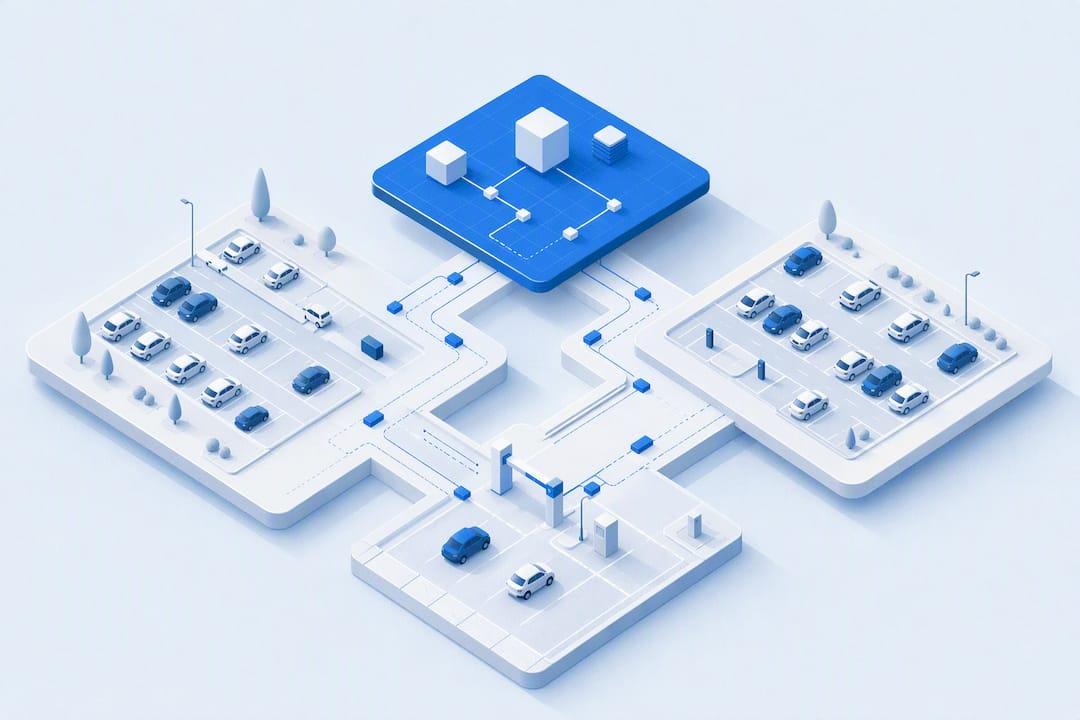
The single most effective way to manage event parking is to build one integrated site-access plan and publish it as a public reservations and information hub before the event, not on the day of it. Two actions matter immediately: assign a dedicated parking coordinator, and put a central parking page live with maps, reservations, and shuttle details. The FHWA Planned Special Events Handbook and tools like PinPark both support this approach in practice.
TL;DR:
- Assigning a dedicated parking coordinator and publishing a central site-access plan before the event significantly reduces onsite chaos and delays.
- Building a detailed zone map with categorized parking and remote shuttles helps manage supply and demand effectively, especially for large or complex events.
- Real-time occupancy data and dynamic pricing platforms like PinPark enable faster decision-making and better staffing during the event.
- Clear early communication through a comprehensive parking page, including maps, shuttle info, and reservation confirmations, prevents last-minute confusion and overload.
- Monitoring key metrics like lot occupancy, queue length, and shuttle loads during the event allows for proactive rerouting and prevents parking backup.
Table of Contents
- Building the plan: feasibility, traffic management, and demand strategies
- Assigning lots, zones, and drop-off areas
- Managing the flow in and out of the venue
- Staffing and coordination across agencies
- Choosing technology for reservations and occupancy tracking
- What to publish, and when, for drivers heading to the event
- Watching the numbers and adjusting as the event unfolds
- Where real-time occupancy and dynamic pricing change day-of decisions
- A simple rule for staying ahead of parking chaos
- Getting started with PinPark
- Where to read the source guidance
- Sources
- FAQ
Building the plan: feasibility, traffic management, and demand strategies
The FHWA planning process moves through three stages: a feasibility study, a traffic management plan, and travel-demand initiatives. Each stage produces something concrete the team can act on, not just a discussion.
Attendance estimates, arrival profiles, and historical data should be segmented by event type, since a sold-out concert behaves differently from a sold-out sports game at both arrival and egress. Averaging the two produces a plan that fits neither. City transportation staff, police, transit agencies, and private lot owners all need a seat at this stage, particularly before permits or road closures are finalized.
Before the event, the coordinator should have in hand:
- A mapped inventory of public, reserved, and overflow parking supply.
- Capacity and demand assumptions tied to the specific event type.
- Contingency triggers for when lots approach capacity.
- Signed agreements with any private lots used as overflow.
Assigning lots, zones, and drop-off areas
Once demand assumptions exist, the next job is turning available supply into a usable map. This means walking the site, counting on-street spaces, parking ramps, and private lots, then building a zone map that staff and drivers can both read.
- Inventory every space, on-street, ramp, and private, and mark each on a single zone map.
- Assign categories: public, reserved, ADA, and staff, before selling a single space, so ADA and staff access never get squeezed out by public demand.
- Design a pick-up and drop-off zone that is physically separate from parking lanes, with a clear pedestrian corridor connecting it to the venue.
- Reserve remote park-and-ride locations with shuttle service for any event where on-site or walking-distance supply cannot cover expected demand.
The FHWA handbook treats public parking, reserved parking, overflow parking, and pick-up/drop-off as the four categories every plan must cover, and it recommends designing lots only after pedestrian and traffic-flow plans are set, not before. When private lots serve as paid overflow, their exits need staffing to meter the outflow, since an unmanaged private lot exit can back up a public street just as easily as a venue gate.
Managing the flow in and out of the venue
Arrival and departure are two separate operational problems, and each needs its own tactics. Upstream signage and traveler information should start managing driver decisions before cars ever reach the site, spreading arrivals across multiple entrances instead of funneling everyone toward the same gate.
- Design entrance service points to process traffic faster than the expected peak arrival rate, not just the average rate.
- Use contraflow lanes or metering at key intersections when inbound volume threatens to spill into public roads.
- Station traffic marshals at decision points where drivers might guess wrong without guidance.
- Set a clear, pre-agreed protocol for calling a lot full: who makes the call, how it reaches drivers, and where those drivers get redirected.
The FHWA handbook notes that parking demand is behavioral: drivers shift between lots based on price or convenience, so a lot-full call that arrives late causes drivers to circle and clog nearby streets rather than move on to the next option.
Staffing and coordination across agencies
A parking plan is only as strong as the people running it on the day. The Corpus Christi parking study recommends a dedicated event coordinator as the single point of control for complex or overlapping events, a role that keeps every other decision from getting stuck between departments.
That coordinator runs a command post, holds pre-event meetings with police, transit, and lot staff, and sets the radio or communication protocol everyone uses on event day. Below that role, staffing needs typically include:
- Gate staff to check reservations and direct traffic into the correct zone.
- Traffic marshals positioned at intersections and decision points.
- Enforcement personnel to handle violations without disrupting flow.
- Shuttle drivers and dispatchers if remote parking is part of the plan.
Briefings before the event, with a written checklist for each role, keep volunteers and contract staff aligned even when they have never worked the venue before.
Choosing technology for reservations and occupancy tracking
Advance reservations cut cash handling at the gate and speed up entry, since a driver with a confirmed spot does not need to negotiate payment on arrival. Real-time occupancy data changes the threshold for making decisions: instead of guessing when a lot is full, staff see it happening and can redirect traffic before backups form.
- Integrate payment processing with access control so a reservation and a gate scan are the same transaction.
- Feed occupancy data into wayfinding signage so drivers see updated lot status, not static numbers.
- Coordinate rideshare pickup zones separately from the main parking flow to avoid crossing paths with pedestrian corridors.
- Plan for installation timing well ahead of the event, since even low-disruption systems need a settling period before the first big test.
Pro Tip: Run a full technology check, reservations, occupancy feed, and signage, at least one week before the event, not the morning of.
PinPark's platform, described on its operator page, applies this model with overhead cameras that generate real-time occupancy data alongside dynamic pricing, aimed at replacing manual lot counts with a continuous feed.
What to publish, and when, for drivers heading to the event
A central parking page does the heavy lifting here. It should include a site map, walking routes from each lot, shuttle schedules, and ADA parking information, all in one place a driver can bookmark before leaving home.
- Publish the event page with parking information as soon as tickets go on sale.
- Send a reservation confirmation immediately after a driver books a spot.
- Follow with a reminder email a day or two before the event, repeating key details.
- Post physical signage and dynamic message signs on approach routes for drivers who did not check ahead.
Pricing and messaging need to stay aligned across every lot in the plan. The FHWA handbook warns that when fees differ between lots, drivers shift toward the cheaper one, which can overload a lot that was never sized for that demand.
Watching the numbers and adjusting as the event unfolds
Once gates open, the coordinator's job shifts to watching a short list of live metrics: lot occupancy by zone, queue length at each entrance, shuttle loads, and transit frequency. Each of these needs a pre-defined trigger, so staff know exactly when to reroute traffic or call a lot full, and who has the authority to make that call.
- Track occupancy and queue length by zone, not just for the site as a whole.
- Set numeric triggers in advance for rerouting decisions, so no one is guessing under pressure.
- Record actual arrival and departure times for the after-action review.
- Hold a short debrief within days of the event, while details are still fresh.
Segmenting this data by event type builds a more accurate baseline for the next event, rather than one generic average that fits nothing well.
Where real-time occupancy and dynamic pricing change day-of decisions
Once a plan is in place, the tools running it determine how fast staff can react. A platform provides real-time occupancy data and dynamic pricing across monitored spaces, replacing manual counts with a continuous feed operators can check from a dashboard.
- Faster lot-full calls, since occupancy updates continuously instead of relying on periodic manual counts.
- More precise staffing, since managers can see which zones are filling and shift personnel there.
- Pricing that adjusts to demand instead of a flat rate set weeks in advance.
- Installation is designed for minimal disruption to existing lot operations.
Details on dashboard access and operator controls are on PinPark's operator page.
A simple rule for staying ahead of parking chaos
Instrument the lots, communicate early, and put one person in charge of the whole picture. Most parking failures trace back to one of these three being skipped, not to a lack of physical space. A single coordinator with visibility into every zone catches a small backup before it becomes a citywide one.
— Noman
Getting started with PinPark
Operators comparing options usually want the same three things: less manual counting, pricing that reflects actual demand, and a system that does not require ripping out existing infrastructure. PinPark's cameras and dashboard are built around exactly that, giving operators a live view of every space without reconfiguring the lot.

Before committing to a pilot, ask any vendor three questions: how much disruption installation causes, what data access operators retain, and how pricing per space works. PinPark's subscription for operators is $10 per month per space, with real-time occupancy and dynamic pricing included. Visit the operator page to review a demo and see if a pilot fits your next event.
Where to read the source guidance

The FHWA Planned Special Events Handbook covers planning and operations in detail. Grand Rapids' parking reservation system and the Corpus Christi parking study offer real-world examples worth reading in full.
Sources
- Managing Travel for Planned Special Events Handbook — Chapter 3
- Grand Rapids trip-planning website and parking reservation system for Acrisure Amphitheater
- Walker parking study — City of Corpus Christi (full report)
FAQ
How much does a parking management system cost?
Costs vary by provider and by the size of the lot being managed. PinPark's operator subscription is priced at $10 per month per space, covering real-time occupancy and dynamic pricing tools.
Is the parking management company legit?
Legitimacy depends on the specific company and what it can show for its work. PinPark has been selected as an Impact Startup at Web Summit Vancouver 2026, which reflects industry and investor recognition.
What are the five C's of event planning?
Definitions of the five C's vary depending on the source, and no single version is universally recognized in event planning literature. Rather than rely on an unverified framework, organizers are better served following a structured process: feasibility study, traffic management plan, and travel-demand initiatives, as outlined by the FHWA.
How much money do parking lot owners make?
Earnings depend heavily on location, capacity, and pricing strategy, and no single figure applies across the industry. Dynamic pricing tools that adjust rates to real-time demand, such as those built into PinPark's platform, are one way operators aim to improve revenue from existing space.
What should a central event parking page include?
A central parking page should include a site map, walking routes from each lot, shuttle schedules, and ADA parking details, all published before the event. Following the FHWA's recommendation to communicate the plan in advance reduces confusion and last-minute rerouting on event day.