
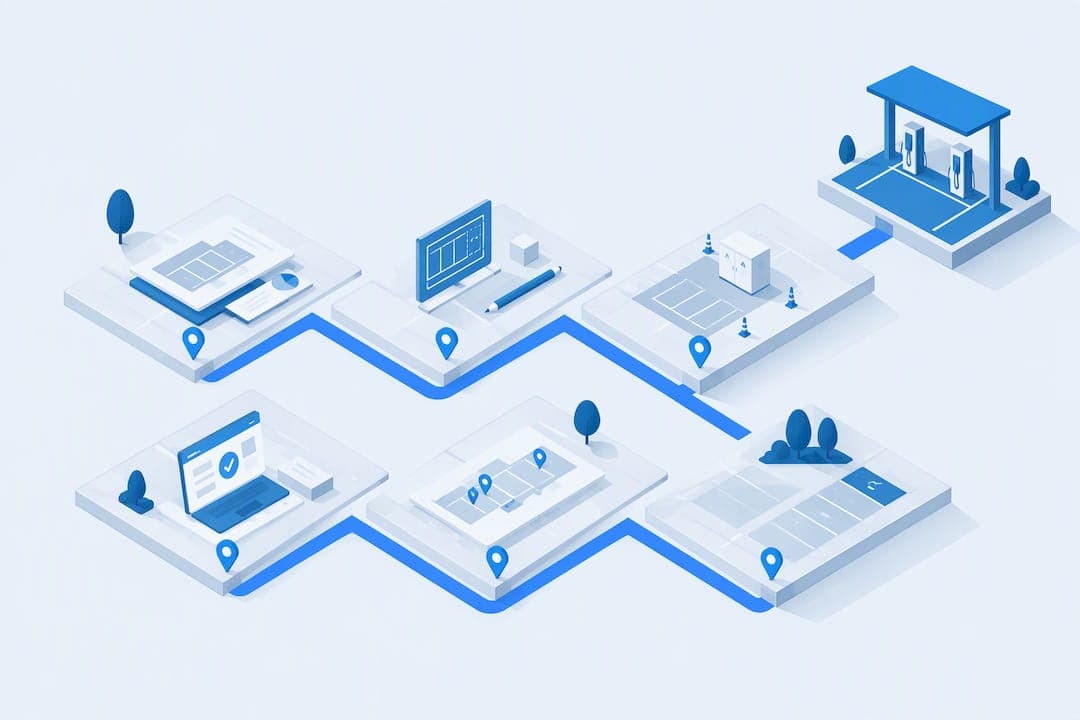
EV charging parking management software must handle real-time occupancy and reservations, pricing and billing, load management, and remote diagnostics in one system. The immediate step is to audit your site's electrical capacity and require OCPP compliance and PARCS integration in any procurement decision, following DOE/AFDC guidance and platforms like PinPark that offer real-time visibility.
TL;DR:
- Proper load management and smart-charging profiles prevent electrical overloads and support demand response, reducing infrastructure costs and system stress.
- Budgeting should include approximately 400 dollars annually per charger for maintenance, with higher costs for fast chargers and extended warranties.
- Implementing phased rollouts with initial pilots minimizes disruptions and identifies electrical or user-behavior issues early, protecting both budget and reputation.
- Real-time occupancy data and integration with PARCS allow for accurate billing, efficient space use, and support utility reporting or demand response incentives.
- PinPark offers real-time occupancy, dynamic pricing, and low-disruption installation through overhead cameras, costing 10 dollars per month per space.
Table of Contents
- Core features to require from EV-charging parking management software
- Pricing, operations & maintenance: realistic budgeting and fee-setting
- Low-disruption deployment checklist for software and charger rollout
- Integration and reporting: the metrics and system links that matter
- Policy, accessibility and standards: the short operator primer
- What real-time occupancy and dynamic pricing change for operators
- Why PinPark fits the operator checklist described here
- Sources
- FAQ
Core features to require from EV-charging parking management software
Choosing software for EV charging parking spaces starts with a clear list of non-negotiable features. Each one affects daily operations, driver satisfaction, and your bottom line differently, so it helps to separate the must-haves from the nice-to-haves before you talk to vendors.
Real-time occupancy tracking for both parking spaces and chargers reduces driver frustration and cuts down on wasted trips to a full lot. Reservations and waitlisting extend that value by letting drivers plan ahead instead of circling the block.
Authentication and billing flexibility matters just as much. Some operators bill per kWh, others per hour or per session, and drivers expect to pay through an app, RFID card, or license plate recognition without friction.
- Real-time occupancy and reservations reduce driver search time and lot congestion.
- Flexible authentication (app, RFID, LPR) and billing by kWh, hour, or session meet different driver preferences.
- Load management and smart-charging profiles prevent panel overload and support demand response participation.
- Remote monitoring and diagnostics cut the number of technician visits needed for routine issues.
- OCPP compliance keeps you from being locked into a single hardware vendor.
Load management deserves particular attention. A site with several chargers pulling full power simultaneously can trip electrical limits, so smart-charging profiles that stagger or throttle sessions protect your infrastructure and open the door to demand response programs. Remote diagnostics reduce the need for a technician to visit every time a charger reports an error, and OCPP compliance protects your investment against a single network provider changing terms later. During event days or periods of high turnover, these same features let staff clear stalled sessions and reassign spaces without walking the lot.
Pro Tip: Ask any vendor to demonstrate OCPP compliance live, not just claim it on a spec sheet.
Pricing, operations & maintenance: realistic budgeting and fee-setting
Budgeting for EV charging parking starts with maintenance costs, not just installation. The Alternative Fuels Data Center estimates about $400 per charger per year for routine operations and maintenance on non-residential charging equipment, with DC fast chargers and extended warranties often pushing that figure above $800 annually.

Around $400 per charger, per year is the baseline maintenance cost operators should plan for on standard Level 2 equipment, before accounting for network fees or software subscriptions.
Setting fees correctly turns that cost into a manageable line item instead of a drain. DOE/AFDC guidance recommends pricing slightly above local residential electricity rates to recover costs and prevent congestion, and offers a fee calculator built for exactly this purpose.
- Per-kWh pricing ties cost directly to energy delivered and is the most transparent model for drivers.
- Per-hour pricing works well where turnover matters more than energy use, such as retail lots.
- Session fees or parking-plus-charging bundles simplify billing for short-term visitors.
- Recurring network and software fees should be folded into your per-session math, not treated as a separate budget line.
A simple cost calculator (electricity plus maintenance plus network fees plus amortized installation) gives you a defensible $/session or $/kWh rate. Pair that rate with enforcement rules that clear idle vehicles from charging spots promptly, since turnover is often what determines whether charging spaces pay for themselves.
Low-disruption deployment checklist for software and charger rollout
Rolling out EV charging parking management software works best as a phased process rather than a single flip-the-switch launch. The goal is to surface problems on a small scale before they affect your whole lot.
- Audit electrical capacity, map available spaces, and estimate demand before selecting equipment or software.
- Confirm OCPP compliance or verify network compatibility with your chosen vendor to avoid future lock-in.
- Launch a phased pilot on one lot or one row of chargers, using overhead cameras or non-invasive sensors that require no reconfiguration.
- Activate charging ports in stages rather than all at once, watching for electrical or usage issues.
- Train staff, post clear signage, and open a soft-launch reservation window to catch problems while volume is low.
- Define a maintenance SLA in writing, including who owns firmware updates and remote diagnostics.
Phased pilots on a single lot or row expose electrical or user-behavior issues early, letting you adjust time limits, reservation rules, and pricing before a full rollout. That approach protects both your budget and your reputation with drivers who show up expecting a working charger.
Pro Tip: Run your soft launch during a low-traffic week so staff can troubleshoot without a backlog of frustrated drivers.
Integration and reporting: the metrics and system links that matter
The value of EV charging parking software depends on what you measure and where that data goes. At minimum, track session count, kWh delivered, revenue, uptime, fault events, and peak utilization windows. Without these, you cannot tell whether charging spaces are earning their keep or quietly losing money.
- Linking charging sessions to PARCS entries creates one billing record for monthly parkers and transient users alike, which reduces reconciliation errors.
- Export formats and API access matter for accounting teams who need clean data without manual entry.
- Utility reporting requirements often call for the same uptime and session data you already collect for internal use.
- Participating in demand response or utility incentive programs can offset a meaningful share of operating costs when your software supports the reporting those programs require.
Session-level reporting and PARCS integration are the two features most likely to separate software that merely runs chargers from software that helps you run a business.
Policy, accessibility and standards: the short operator primer
Federally funded EV charging projects operate under the NEVI minimum standards, which set requirements for interoperability, data submission formats, and public-access pricing transparency. Even operators outside federal programs benefit from following these as a baseline.
- NEVI and DOT rules require standardized data reporting and open network interoperability for federally funded chargers.
- ADA-accessible design should factor into any new charging parking space, including access aisle width and reachable equipment height.
- Reporting tied to utility or federal incentive programs is easier when your software already tracks uptime and session data.
- Public-sector procurements may require additional security review, including data-handling standards appropriate to government contracts.
What real-time occupancy and dynamic pricing change for operators
Visibility is the starting point for everything else. Once you can see, space by space, how a lot performs, you can set prices that match real demand instead of guessing. That pricing then funds the staffing decisions and expansion plans that follow.
Installations that avoid major lot reconfiguration matter more than most procurement checklists admit, since disruption during rollout is often what operators remember longest. Prioritize data ownership and interoperability over any single vendor's roadmap. Operators who keep control of their own data keep their options open.
— Noman
Why PinPark fits the operator checklist described here
The solution maps directly onto the requirements this guide covers: real-time occupancy data, dynamic pricing, reservations, and a low-disruption install using overhead cameras rather than pavement sensors or lot reconfiguration. That combination means facility managers get space-level visibility without the downtime a full electrical retrofit usually requires.

PinPark was recognized as an Impact Startup at Web Summit Vancouver 2026, a signal worth noting alongside the operational fit. The PinPark subscription is priced at $10 per month per managed space, giving operators a straightforward cost basis to weigh against the maintenance and network fees covered earlier in this guide. Facility managers ready to see the dashboard in action can visit the operator page to request a demo.
Sources
- Operation and maintenance for electric vehicle charging infrastructure | AFDC
- NEVI final rule and guidance | US Department of Transportation
- EV charging management software for parking facilities | Parking Professional
FAQ
What features should EV charging parking software include?
Look for real-time occupancy and charger status, flexible billing by kWh, hour, or session, load management, and remote diagnostics. OCPP compliance is also essential to avoid being locked into one hardware vendor.
How much does it cost to maintain an EV charger each year?
Routine maintenance for a standard charger runs about $400 per year, according to AFDC estimates. DC fast chargers with extended warranties often cost more than $800 annually.
Should charging fees be higher than local electricity rates?
Yes. DOE/AFDC guidance recommends pricing slightly above residential electricity rates to recover operating costs and discourage drivers from occupying a charging space longer than needed.
What are NEVI standards and do they apply to my lot?
NEVI standards are federal requirements for interoperability, data reporting, and pricing transparency on federally funded charging projects. They apply directly only to funded projects, though many operators use them as a general benchmark.
How does PinPark help manage EV charging parking spaces?
PinPark uses overhead cameras to provide real-time occupancy data and dynamic pricing tools without requiring lot reconfiguration. The PinPark subscription costs $10 per month per managed space.