
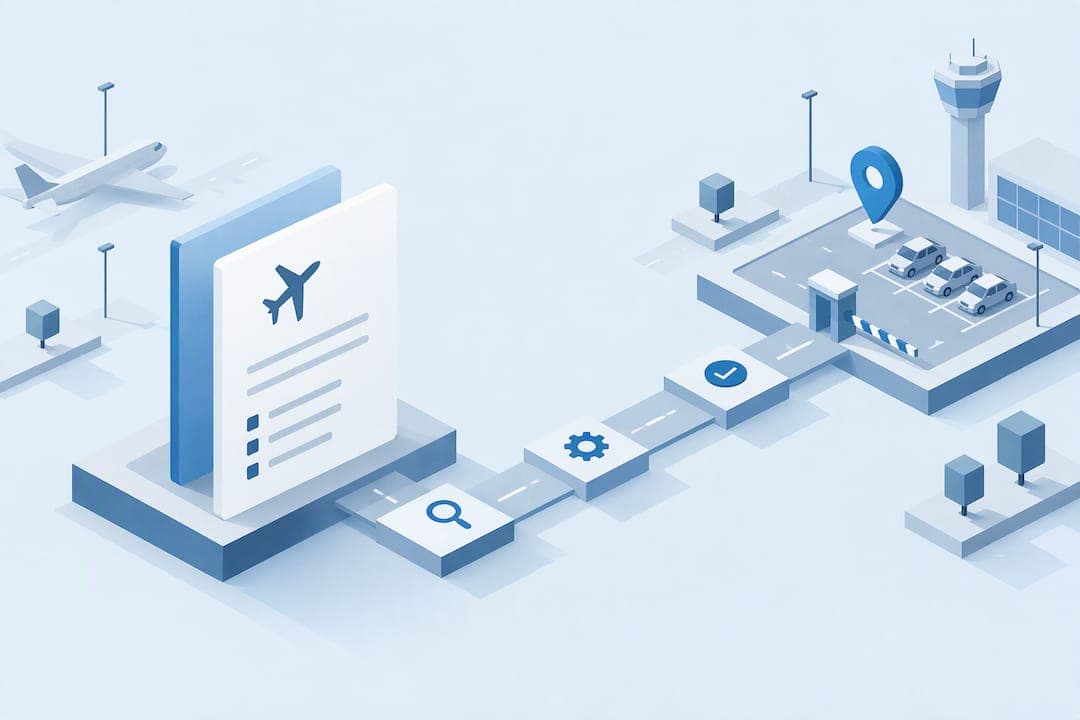
Adopt an integrated, performance-based parking management model that pairs real-time occupancy visibility with yield management, reservation products, and a contracting structure tied to measurable KPIs. This approach captures more revenue per space, reduces terminal-area congestion, and gives procurement teams a defensible way to evaluate vendors. The sections below break down the specific levers, technology requirements, and an RFP checklist you can apply immediately.
TL;DR:
- Real-time occupancy data at the stall level enhances pricing accuracy and reduces congestion, especially when paired with overhead cameras over pavement sensors.
- Tracking key metrics such as revenue per space, occupancy against targets, and prebooking share for at least 90 days is essential to measure technology improvements effectively.
- An integrated performance-based pricing model should strategically open one to two stalls per block during peak periods to optimize revenue and space utilization.
- The optimal operational contract depends on your airport's control preferences, with management contracts and lease models requiring specific contractual provisions like weekly reporting and SLAs.
- Technology deployment should prioritize open API access and system integration to support curb management, enforcement, and TNC coordination, with camera-based solutions preferred for quick installation.
Table of Contents
- What Makes Airport Parking Management Profitable?
- What Are the Most Common Airport Parking Problems?
- Which Operational Model Fits Your Airport?
- How Should You Price and Structure Parking Products?
- What Technology Do You Actually Need?
- Which KPIs and Staffing Practices Protect Net Income?
- How Do You Structure an RFP or Pilot Program?
- How AI-Driven Visibility Changes Daily Operations
- How Pinpark Fits the Integrated Model
- Where to Read More
- Sources
- FAQ
What Makes Airport Parking Management Profitable?
Parking ranks among the largest non-aeronautical revenue lines at most hub airports, and its performance depends heavily on factors airports can influence directly. A a panel study of 62 U.S. hub airports covering 2017 through 2023 found that locally originating passenger volume, the share of low-cost carriers, economy parking price, and competition from off-airport lots all move revenue in measurable ways.
Yield management and prebooking shift more of that demand into predictable, higher-margin channels. When travelers book a space before they arrive, terminal-area circulation drops because fewer cars are searching for open stalls. That translates into shorter curb dwell times and fewer complaints tied to "lot full" signage.
Track these metrics from day one:
- Revenue per available space, by product tier
- Occupancy rate against a target ceiling, not just total cars parked
- Prebooking capture rate as a share of total transactions
- Average search time from facility entry to space selection
Pro Tip: Pull baseline occupancy and revenue data for 90 days before any technology change. Without it, you cannot prove the lift a new system delivers.
What Are the Most Common Airport Parking Problems?
Most airport parking failures trace back to five recurring issues, each with a practical fix decision-makers can implement without a full facility overhaul.
- Availability mismatch. Lots read as full when spaces sit empty because nobody tracks real occupancy at the stall level. Overhead occupancy sensors combined with a reservation system create a virtual inventory that matches supply to actual demand.
- Curb congestion from ride-hailing growth. Transportation network companies compete for the same curb real estate as parking customers. Curb zoning and designated pickup zones separate these flows and cut dwell time.
- Revenue leakage. Cash handling and ticket reconciliation gaps are common; an audit at John Wayne Airport found fee billing that wasn't adequately supported against gross receipts. Daily PARCS reconciliation and explicit remittance terms close that gap.
- Labor mismatch. Staffing schedules built around fixed shifts, not actual flight or occupancy patterns, waste payroll during slow periods and understaff during surges.
- Product complexity. Confusing tier names and pricing confuse travelers. Nested product design with clear naming (economy, preferred, valet) fixes this at the UX level.
Which Operational Model Fits Your Airport?
Three contracting structures dominate airport parking: self-operate, management contract, and lease or concession. Each allocates risk differently, and the right choice depends on how much capital and control your airport wants to hold.
- Self-operate: the airport keeps all revenue and expense risk, along with full operational control.
- Management contract: an operator runs day-to-day activity for a fee, while the airport retains revenue risk and upside.
- Lease/concession: the operator assumes revenue risk in exchange for a fixed or percentage payment to the airport, per National Academies guidance on ground-transport revenue models.
Whichever model you choose, the contract language matters as much as the structure. Require weekly revenue reporting, direct PARCS system oversight rights, a clearly defined missing-ticket liability policy, and service-level agreements with financial penalties attached. The Miami International Airport management agreement is a useful reference for how term length, PARCS access, and financial handling obligations get written into binding language.
How Should You Price and Structure Parking Products?
Performance-based pricing is the primary lever for hitting occupancy targets without turning customers away. Municipal parking planning guidance recommends keeping one to two stalls open per block during peak periods, a target that translates directly to airport garages and surface lots.
Build your product ladder around distance and convenience:
- Remote/economy lots priced lowest, positioned to absorb long-term and leisure travelers
- Terminal-adjacent tiers priced higher for business travelers who value walk time
- Valet as the premium tier, with pricing that reflects labor cost plus convenience.
DFW's prebooking program advertises savings up to 50% off drive-up rates, which shows how far ahead-of-arrival discounts can shift demand into predictable channels. Automate small, frequent price adjustments based on real-time occupancy. Reserve manual review for large swings tied to holidays, weather, or flight schedule disruptions. Loyalty programs and targeted promotions protect base yield by rewarding repeat parkers without discounting your peak-demand inventory.
What Technology Do You Actually Need?
A modern parking technology stack needs five components working together, not five separate systems that don't talk to each other.
- PARCS (parking access and revenue control systems) for gate control and transaction processing
- License plate recognition (LPR) for touchless entry/exit and enforcement support
- Overhead occupancy cameras for real-time, stall-level visibility instead of estimated counts
- Mobile reservation and payment platforms for prebooking and contactless transactions
- API access so occupancy and revenue data feed your existing accounting and curb-management systems
Require real-time occupancy by zone, transaction-level reporting, and open API access in any procurement specification. Integration priorities should extend past the lot itself to curb management, TNC coordination, and enforcement systems, since parking decisions increasingly affect access mode choice, not just parking demand, according to research on airport mode and parking choice using DFW passenger survey data.
Pro Tip: Favor camera-based occupancy detection over pavement sensors when minimizing construction disruption is a priority. Overhead installation avoids the lot closures that sensor trenching requires.
Which KPIs and Staffing Practices Protect Net Income?
Five KPIs cover the core of parking performance:
- Occupancy by product tier, so you know which price band is underused
- Revenue per space, the single best normalized measure of yield
- Capture rate, the share of total demand your prebooking channel captures
- Missing-ticket rate, a direct proxy for revenue leakage
- Average transaction value, tracked against your pricing changes
Dynamic rostering, staffed to flight schedules and live occupancy signals rather than fixed shifts, keeps labor cost aligned with actual demand. Contracts should require daily cash and PARCS reconciliation, since audit findings from parking concession reviews repeatedly flag billing and labor-hour discrepancies as the most common source of disputed payments. Bill operators against actual worked hours, not scheduled hours, to avoid one of the most persistent reconciliation fights in airport parking contracts.
How Do You Structure an RFP or Pilot Program?
An effective procurement process runs through four stages, each with specific deliverables.
- Draft RFP requirements covering API and data export capability, settlement mechanics, performance SLAs, a documented missing-ticket policy, and compatibility with your existing PARCS infrastructure.
- Scope a pilot with clear success metrics: occupancy accuracy against a manual audit, revenue delta versus the prior period, and any measurable NPS change from customer surveys.
- Plan the rollout in stages, with a fallback path if integration issues arise, plus customer communications and enforcement alignment before full deployment.
- Score proposals against four categories: technical capability, financial terms, operational fit, and product roadmap.
Weight technical capability and financial terms roughly equal, since a technically strong platform with unfavorable settlement terms still erodes net revenue over a multi-year contract.
How AI-Driven Visibility Changes Daily Operations

Space-level occupancy data shortens the pricing decision cycle from days to hours. When you can see which zones sit empty at 2 p.m. instead of estimating from gate counts, staffing adjustments follow the same day, not the next billing cycle.
The adoption lesson worth repeating: prioritize deployments that avoid lot reconfiguration. Camera-first installs that layer onto existing PARCS infrastructure get airports to usable data faster, with pilots typically showing occupancy accuracy and revenue delta improvements within the first measurement cycle.
— Noman
How Pinpark Fits the Integrated Model
Pinpark maps directly onto the levers this guide just walked through. Real-time occupancy monitoring with overhead cameras replaces guesswork with stall-level visibility. Dynamic pricing tools operationalize the performance-based pricing this guide recommends, without a manual repricing team. A driver-facing reservation app supports the prebooking capture rate you need to track, and installation is built to avoid the lot reconfiguration that slows down most technology rollouts.

If you're scoping a pilot, request three numbers from any vendor: occupancy accuracy against a manual count, revenue delta over 90 days, and time-to-data from installation to a usable dashboard. Pinpark's operator platform is built to answer all three, with current pricing details available on their site. Visit the operator page to request a demo and see what a pilot scope looks like for your facility.
Where to Read More
The commercial case for parking's role in airport revenue is laid out in a panel study of U.S. hub airports covering revenue drivers from 2017 to 2023. The National Academies resource covers forecasting and revenue management guidance in depth. The Miami International Airport management agreement and DFW's prebooked parking page offer real contract and product examples worth reviewing before you draft your own RFP.
Sources
- What drives the dynamics of airport parking revenues? A panel study of U.S. airports
- Parking | DFW Airport (Prebooked Parking)
- Rethinking parking to enhance airport revenues (National Academies resource)
- NON-EXCLUSIVE MANAGEMENT AGREEMENT FOR THE OPERATION OF THE PUBLIC PARKING FACILITIES AT MIAMI INTERNATIONAL AIRPORT
FAQ
Is Airport Parking Management Software Legitimate?
Yes, established platforms in this category use verifiable technology like overhead occupancy cameras, license plate recognition, and PARCS integration that airports can audit directly against actual counts. Ask any vendor for a reference pilot and request occupancy accuracy data before signing a contract.
How Much Does Long-Term Parking Cost at Springfield-Branson National Airport?
Springfield-Branson National Airport lists separate rates for short-term and long-term parking on its own parking information page, with vendor contact details included for current pricing. Rates vary by season and lot, so check the airport's page directly for current figures.
What Does Airport Parking Management Actually Involve?
Airport parking management covers pricing, staffing, technology operations, and contract oversight for every parking facility an airport operates, from curbside valet to remote economy lots. It increasingly means treating parking as part of the broader ground-transportation ecosystem, coordinating pricing with curb access and rideshare zones rather than managing lots in isolation.
How Do I Contact DFW Airport Parking Support?
DFW Airport's Parking Guest Relations team can be reached at +1-972-973-3112 or by email at finparkingrev@dfwairport.com. The airport's parking page also lists prebooking options with savings up to 50% off drive-up rates.
What Does Pinpark Cost for Airport Parking Operators?
Pinpark's operator subscription is priced at $10 per month per managed space, covering real-time occupancy monitoring, dynamic pricing, and reservation management. Installation uses overhead cameras and is designed to avoid lot reconfiguration during setup.